In essence the first thing you need to know is that there are currently five public transport networks in Paris which are :
The métropolitain (métro) underground train network. Trains stop at all stations, except where there is work going on in a particular station. This is probably the most used network as it covers all of central Paris.
The Réseau Express Régional (RER) suburban train network. The RER trains only stop at stations indicated by the overhead information panels on the platform. There are often two information sources on the platforms - a TV like screen which only shows the times of the next trains expected into the station and then an information panel like you find in airports which flicks over when it changes. It's the second one that will tell you where the train will stop. RER trains usually have a four-letter identifier on the front such as VIPE or ELSA. This identifier is known as the "mission" and indicates which stations are served. If you look along the walls on the platform you may find a timetable showing the details of the different missions. Finally, all RER trains pass through central Paris and they serve towns throughout the Ile-de-France region.
The SNCF (Société Nationale des Chemins de Fer) as well as providing high-speed rail links to most large towns in France, does also provide some local services around the Ile-de-France region. These are very similar to the RER services and, in fact the main difference is simply the fact that these services come under the jurisdiction of the SNCF. If you have to use these lines, count yourself lucky - I always found that the SNCF have a much greater awareness of customer service than the RATP and pride themselves on being extremely reliable.
The bus network which covers central Paris and also extends out into the Ile-de-France region. The buses cover central Paris like the métro, but just a bit differently. Buses have to contend with traffic and this is worth bearing in mind if you need to get somewhere fast and it's rush hour ! Buses only stop if someone has pushed the button which lights an "arrêt demandé" sign at the front of the bus above the windscreen or to pick up passengers. However, as buses have two doors and you are expected to get off at the one in the middle and get on at the one at the front, don't rely on passengers getting on as your way of getting off - I've seen some drivers refuse to activate the middle doors because nobody pressed the button !
There are also two tramlines, one of which links Saint-Denis to Bobigny-Pablo Picasso, the other links La Défense Grande Arche and Issy-Val de Seine.
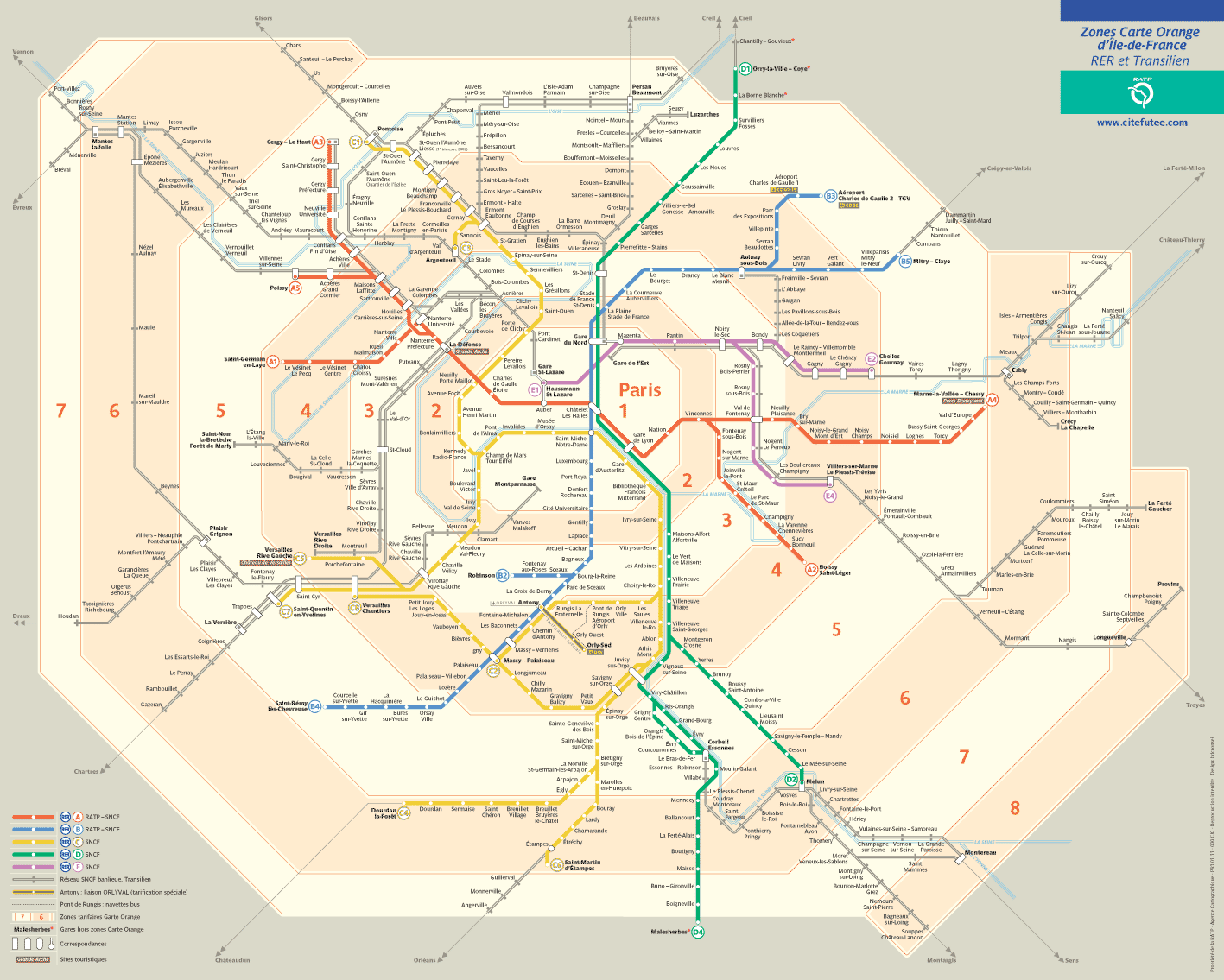
Generally speaking, you can get information about the network from any ticket office. You can normally get free maps and information about tariffs. You should be aware that the Ile-de-France region is divided into 8 zones as you can see shown by the circles below. Click here to see the zones map full size.
The zones shown above apply to the RER and SNCF networks. To give you some idea of the scale of the area covered by the zones, the métro network is more or less confined to zones 1 and 2. Therefore if you are using the RER or SNCF networks you should ensure that your ticket is valid for travel in the zones you will be passing through. Buses and trams have their own tariffs and to the best of my knowledge, it is now the case that 1 RATP zone urbaine ticket (8F) - obviously times have changed since ! (anyone with the price in €uros, please let me know) is valid for a single journey on the buses and trams, no matter how many zones are crossed, though transfers are not permitted on the same ticket. As far as I know, a single métro ticket (8F) is valid for your entire journey including transfers until you exit the network. For the latest information on tariffs, see the RATP (Régie Autonome des Transports Parisiens) website.
If you are simply passing through Paris on your way to somewhere else you should simply check where you will be arriving and where you need to get to, in order to determine how you should travel. If you are arriving in the Gare du Nord (Eurostar terminal) and you need to get to Montparnasse or the Gare de Lyon to get a TGV connection, you only need to get a standard single ticket (8F) as you can confine your journey to zones 1 and 2 of the métro / RER network. On the other hand if you will be arriving at one of Paris two main airports : Orly or Charles-de-Gaulle then you should buy a ticket to the appropriate station from a ticket office. If you are travelling to a station in zones 1 or 2 of Paris then your ticket will probably just state Paris as the destination.
DO NOT BUY TICKETS FROM PEOPLE LOITERING AROUND TICKET MACHINES EVEN WHEN THESE MACHINES ARE OUT OF ORDER. TICKET OFFICES ARE ON HAND. YOU RISK A FINE OF ABOUT 250F IF YOU ARE CAUGHT TRAVELLING WITHOUT A VALID TICKET. Regular checks are carried out and a couvert watch is often kept on ticket machines at the entrance to stations to spot people jumping the barriers. Ticket inspectors are then warned by radio and are ready to intercept culprits in advance.
If you are going to be living in the Paris region and will be using the transport networks every day, then your best bet is to go for a carte orange. You need to supply a photo for this. You will get a card with a number on it and you have to fill in your name on the card and attach your photo. Peel off the strip and stick the clear plastic cover over your photo. You should write your address on the back and sign your card. This part of the carte orange is not valid for travel alone. You actually need to get a ticket which states the zones that the card is valid for as well as the dates on which it is valid. You can get weekly (hebdomadaire) tickets as well as monthly (mensuel) tickets. The monthly tickets are on average marginally cheaper than 4 weekly tickets. In any case, before you travel, make sure you write the number of your card onto the ticket. It is not strictly valid until you do this and it renders your ticket useless to anyone else should they try to pass it off as theirs to inspectors who should notice that the ticket's number differs to the number on their card.
If you are planning a day out and you will need to travel around outside the zones that you normally use, your best bet will be the carte mobilis which is similar to the carte orange in that it states the zones that it's good for travel in. It differs in that you don't have to supply a photo for it and also that the tickets for it are only valid for one day, so there may be circumstances where it isn't worth using a carte mobilis and it would be just as cheap to use single tickets. As a general rule, I'd suggest that if you are going to be making two or more return journeys in a day outside your normal zones that there is a good chance that the carte mobilis will turn out to be the cheaper option.
Using the métro
To plan out an itinerary on the métro, you first need to locate your departure and destination stations. When you have done that, look to see if there is one line which serves both stations. If so, you're lucky - you won't have to change trains. If noot, find a way of completing the journey using transfers (transfer stations are indicated with a white circle). When you arrive at your departure station, find the appropriate line (1, 2, 3 etc.) and check in which direction the train you want to get should be going in (the direction is indicated by the names of the stations at each end of the line). Make your way onto the appropriate platform and wait for the train to come. When it arrives on the platform you may have to lift a lever, or push a button to open the doors. Make sure you get off at your transfer station or your destination. If you are transferring, follow the "correspondance" signs for the appropriate line and then find the platform for the appropriate direction. When you arrive at your final destination look for the signs marked "sortie" which will take you out. Some stations have several different sorties, so if you know which one you need to go to look for the name of the street marked underneath. If you do happen to "overshoot" and miss your destination or transfer, just find the way across to the other platform (normally you can go up a flight of steps and then cross over). Wait for the next train and this will take you back the way you came. This means that you don't have to exit through the machines and thus have to use another ticket.
Using the RER / SNCF banlieue
Find your start and end stations. Check which route to take between the two (transfer stations are indicated by a white area joining two or more lines). When you get to your start station, find the appropriate line (A, B, C, D, or E for the RER) and find the appropriate platform with reference to the direction the train will be travelling in. When you get to the platform check with the overhead information screens which train will be arriving next. Check with the overhead information panels that train which is arriving next will serve the station that you want to get off / change at. Generally speaking most trains stop at the main stations in central Paris, however do check - if you get it wrong you could end up in the suburbs, several zones past where you wanted to go without a valid ticket ! For main line SNCF trains you need to get a proper SNCF ticket which looks more like an aeroplane ticket than a metro ticket.
Using the buses / trams
As with any bus service you should decide which route you are going to take, find a bus stop which shows the number of the bus you intend to catch and make sure that you are on the right side of the road for the direction you wish to travel in. Be aware that buses in Paris can be subject to disruption due to traffic conditions and also public demonstrations.
Don't forget to stamp your ticket !
If you are using the métro or RER you should always put your ticket into the ticket machines and collect it when it comes through at the other end. Also in the buses and trams you should stamp your ticket so that it is valid, EXCEPT if you have a carte orange. With a carte orange you are supposed to flash it as you walk past the driver. The reason you shouldn't use the machines in the buses and trams is that they usually punch a hole in the ticket which might make it unusable in the métro or RER. If it's a single journey ticket that doesn't pose a problem. Another thing that you might like to know is that RER tickets which are valid from or to Paris are valid for a journey on the métro network (the whole journey being completed in one go).
This is only a rough guide, but as far as I know it is correct. For maps of the transport system click here. Check with the RATP or SNCF for precise information.
Return to my experiences as an English language assistant working in the Paris suburbs during 1999 / 2000.
All messages, comments and suggestions are welcome. Please use my feedback form to contact me.
Updated 9th February, 2003.